post / June 1, 2017
6 Levels of Automation (Remastered)
A remastered version of the six levels of automation framework.
This is a remastered version of a popular “6 Level of Automation” post.
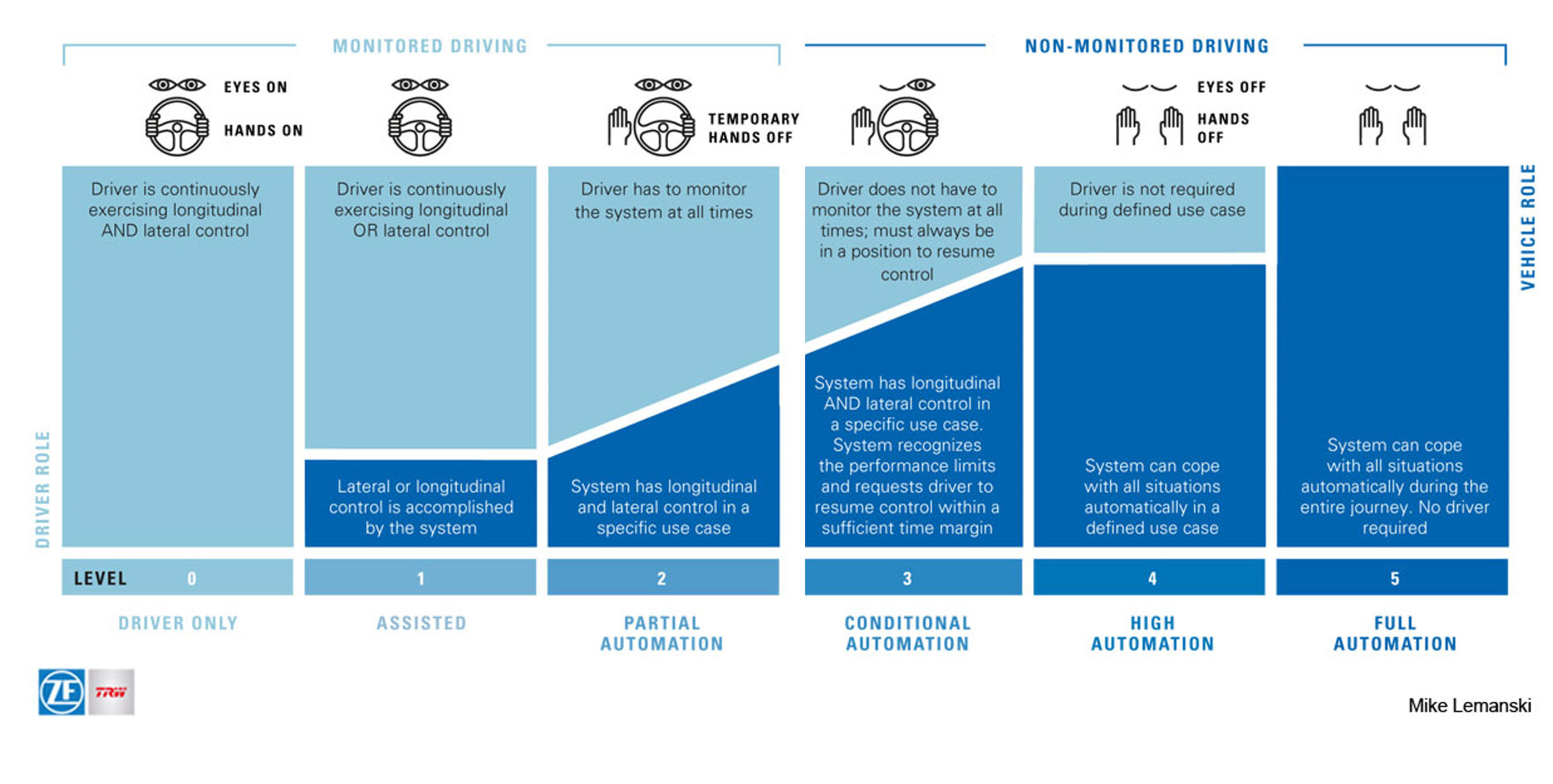
It is common knowledge that cars are on their way to become self-driving. Well-understood levels of automation have now become popular in auto industry. These levels are used to measure up competition and are now even used by regulators in US and Europe to steer the evolution of the auto industry. Here are 6 levels of car automation:
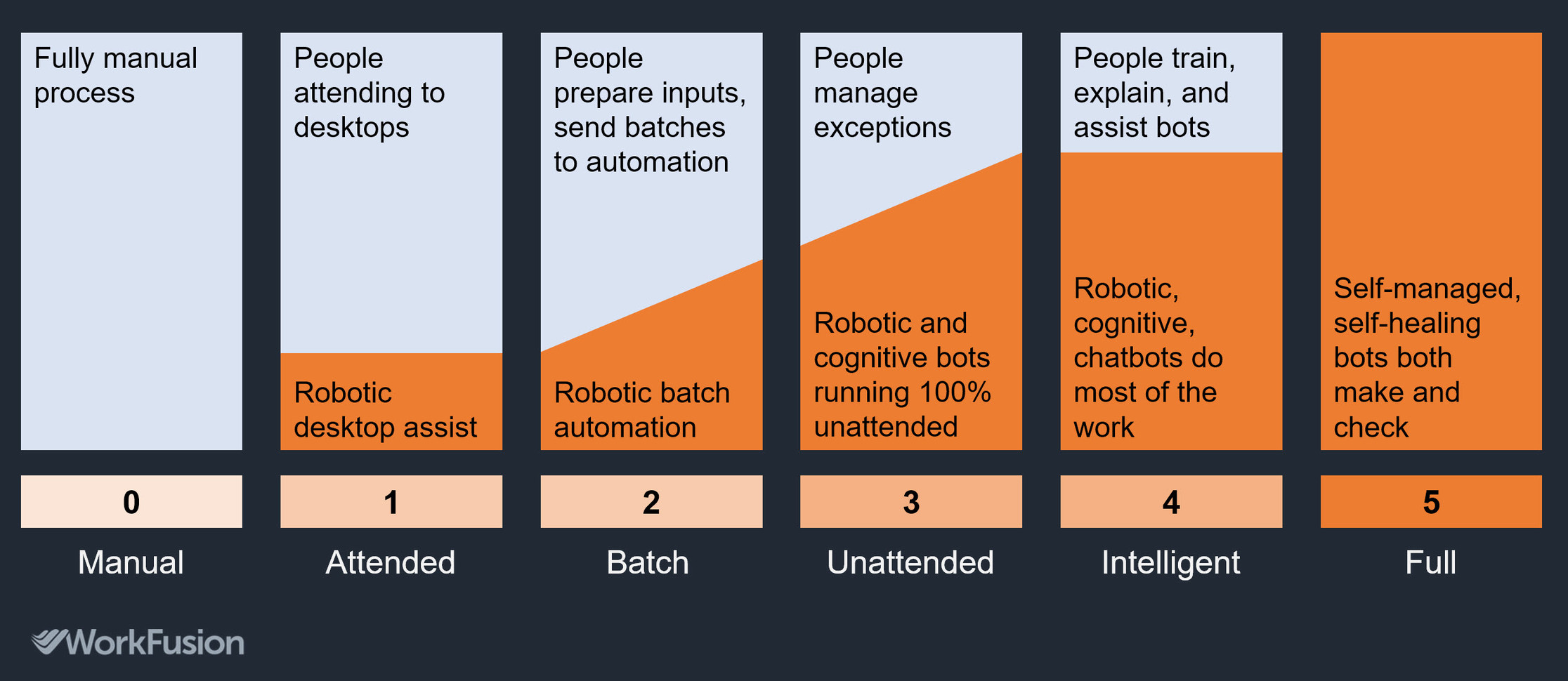
How would these levels look like in Automation world?
Level 0: Manual
At this level 100% of work is done manually. Manually does not mean “no technology”. With traditional cars, drivers use automotive technology but they do it in an “analog way” by fueling, driving and navigating cars and car fleets manually. Today’s typical operations teams also use workflow technology, but also do it in an analog way by installing software, mapping processes, and managing workloads.
Level 1: Attended Automation
At this level, helper bots enter the scene. With cars, this level of technology is analogous to cruise control and lane departure warnings. Driver still needs to drive the car 99% of the time under most conditions. In operations world, this level is described as “assisted Robotic Process Automation (RPA)” or “Robotic Desktop Automation (RDA)”. At this level, person still does their work in an old way and uses the desktop most of the time. Bots are recorded often by operators and kick in as assistants under certain conditions and help perform simple tasks like copy-paste across multiple application windows.
Level 2: Batch Automation
At this level, industrialization of automation begins. With cars, this level of technology is analogous to automated parking. Something that drivers do very often under fairly predictable conditions gets automated almost 100%. It does not work all the time but it often does. In operations world, this is often referred to as “batch RPA” or simply “RPA”. Bots are created by process owners, batches of common simple tasks are prepared manually and then executed by bots without a person watching the desktop 99% of the time. If something goes wrong, automation simply aborts with an “exception” and then a person needs to figure out what to do and restart it.
Level 3: Unattended Automation
At this level, automation is starting to manage. With cars, this level of technology manifests as automated highway driving. Once engaged, technology can drive the car under a range of conditions and alert the driver when intervention is needed or even allows the driver to contribute to driving without fully disengaging. In operations world, this is called “unattended RPA”. This level of technology involves the ability of automation platform to include and manage manual interventions such as data-driven exceptions or review/approve tasks without aborting automation.
Level 4: Intelligent Automation
At this level, automation is starting to learn. With cars, this level of technology is actively pursued by most manufacturers but is most prominently exploited and marketed by Tesla. At this level, technology does not simply ask for the driver intervention under the unexpected conditions. It is using real-world inputs, its own and driver’s decisions to improve future performance of both the car and the fleet. In operations, this level is called “Intelligent Process Automation (IPA)” or “Smart Process Automation (SPA)”. Automations does not simply click around on buttons, they collect and analyze data processed to automatically match workloads to people and bots, identify bottlenecks, and route workflows. Work changes from completing process tasks to training bots, explaining learned behaviors, and managing bot-people workforce as one.
Level 5: Fully Automated
This level is still a future state. Cars of the future wont have steering wheels. It will be both safer and more important for people to focus on managing auto fleets, planning destinations, and spending their time on non-driving while being moved. Operations teams also wont use technology with a “steering wheel”. Scripting robotic bots and building machine leaning models will go by the way of switching gears and using paper maps. Operations teams of the future will manage customer experience workloads, source and plan their digital workforce, and serve customers.
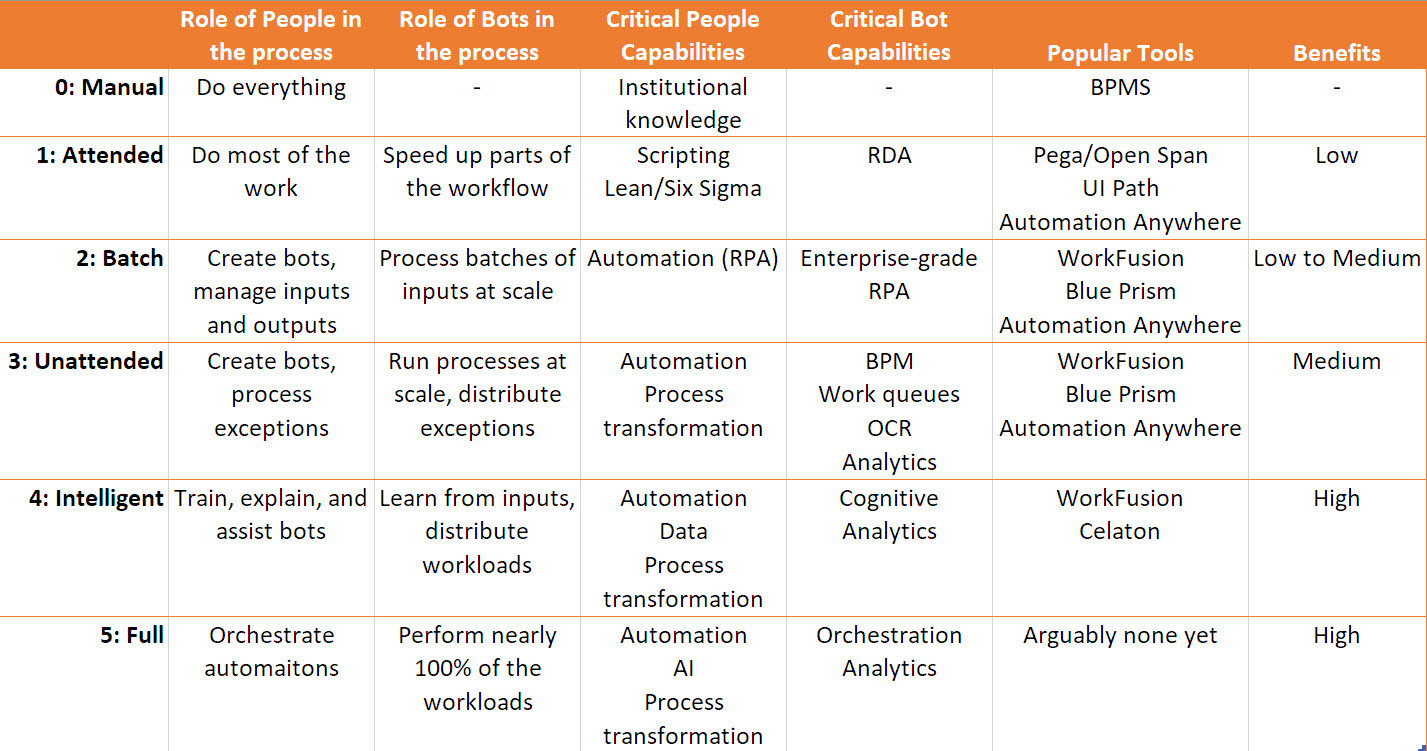
So there you go: 6 levels of automation:
Originally published on LinkedIn.