post / December 28, 2025
On limits of automation: 20% of Jobs are in ROI Nooks
20% of work cannot be automated despite us "having the technology" because it cannot be touched by this technology.
20% of work cannot be automated despite us "having the technology" because it cannot be touched by this technology:
In theory, there is no difference between theory and practice; in practice, there is.
In practice, automation projects get smaller over time
As technology advances, automation implementation projects get smaller:
- Low-hanging fruit go first → leftover work is niche → automations are smaller
- BigTech productizes common workflows → gaps remain → implementations shrink
- Reusable modules accumulate → less net-new build → projects become smaller
- Standards improve → custom integration drops → work splits to small connectors
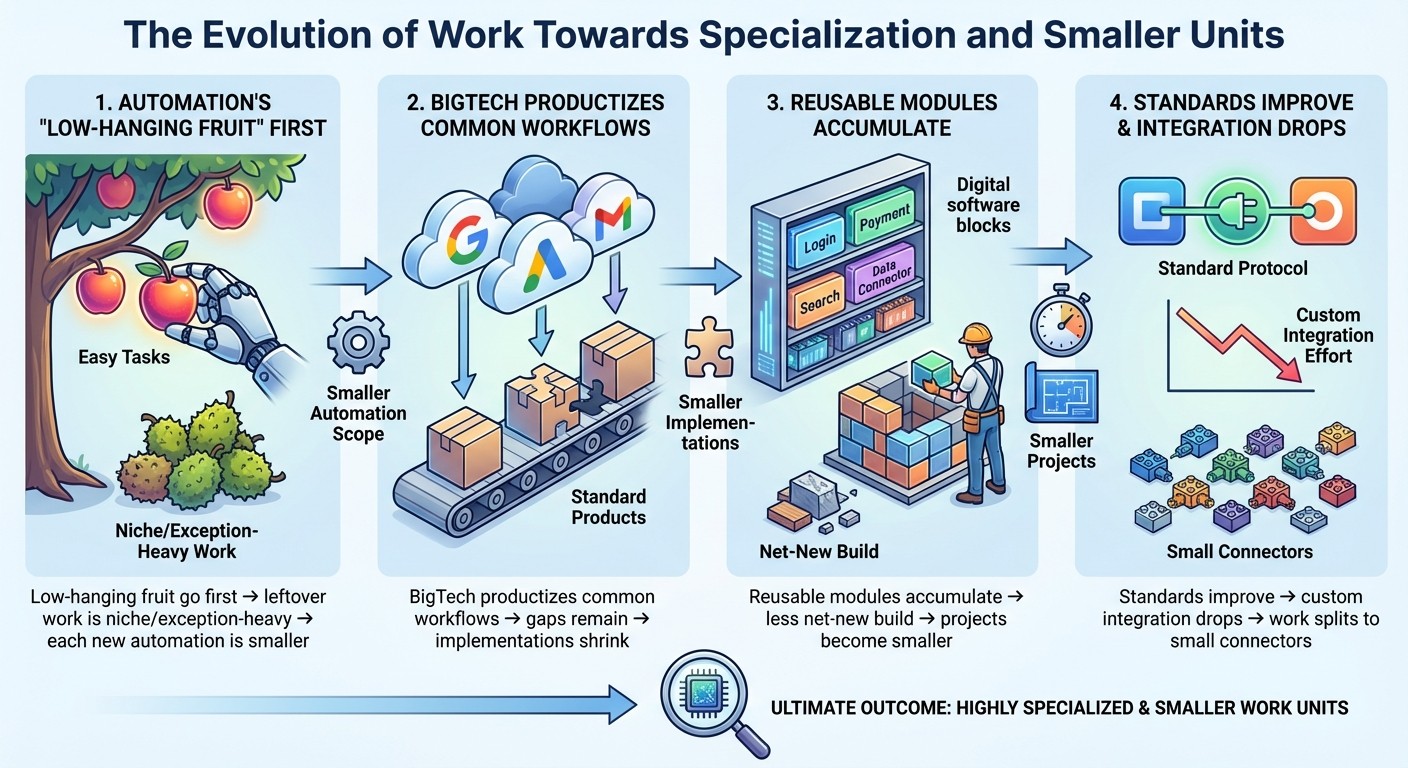
NanoBanana!
Even in the largest businesses with very large operations teams (500+ FTE), in practice discrete automation opportunities are about very small teams (5-10FTE).
In theory, automation progresses by "miniaturizing" tech
Reaching far-flung parts of the human body required nature to evolve tiny capillaries. So is the case with automation - "reaching" small automation projects can be done with agile "software capillaries". Besides overcoming organizational cost of "doing things in a firm", software must be:
- Self-serve technology that has low provisioning cost
- Easy-to-use tools that do not require professional services
- Composable + interoperable tools that plugs into existing systems
- Observable tech that helps keep safety and trust in check
Every once in a while there comes a packaging of tech that promises step-function change in "miniaturization" of software: "lower-cost tech that can eliminate all this manual work".
Robotic Process Automation captured the minds of enterprise buyers in 2018. RPA was a quadfecta promise: desktop bots (self-serve) built by citizen-developers (easy-to-use) using GUI of existing apps (interoperable) on a common RPA platform (observable).
RPA did address previously unaddressed use cases but fell short of the hype it created. There were a lot of customers citing numbers of bots they built: 10, 100, 1000! However, today combined RPA revenue is $5b? (UIPath + Power Automate + AA + ?) representing 1% of software market. RPA firms raised A LOT of capital and are just now starting to reach profitability so arguably the segment is still just digging itself out of the hole.
Disclaimer: I experienced this firsthand as a CEO of an RPA company in 2015-2020 era.
In theory, AI Agents promise step-function change
- Self-serve: "What shall you build today?" vibe-coding is on every other home page.
- Easy-to-use: "If you don't know how to use it, just ask it how to use it."
- Composable + interoperable: MCP, A2A, CUA = RPA+++
- Observable: "just ask it what it did".
Just like in during the RPA wave, there are companies already touting the number of agents they built.
In practice, AI Agents are incremental
Let's compare AI agent TCO to RPA TCO:
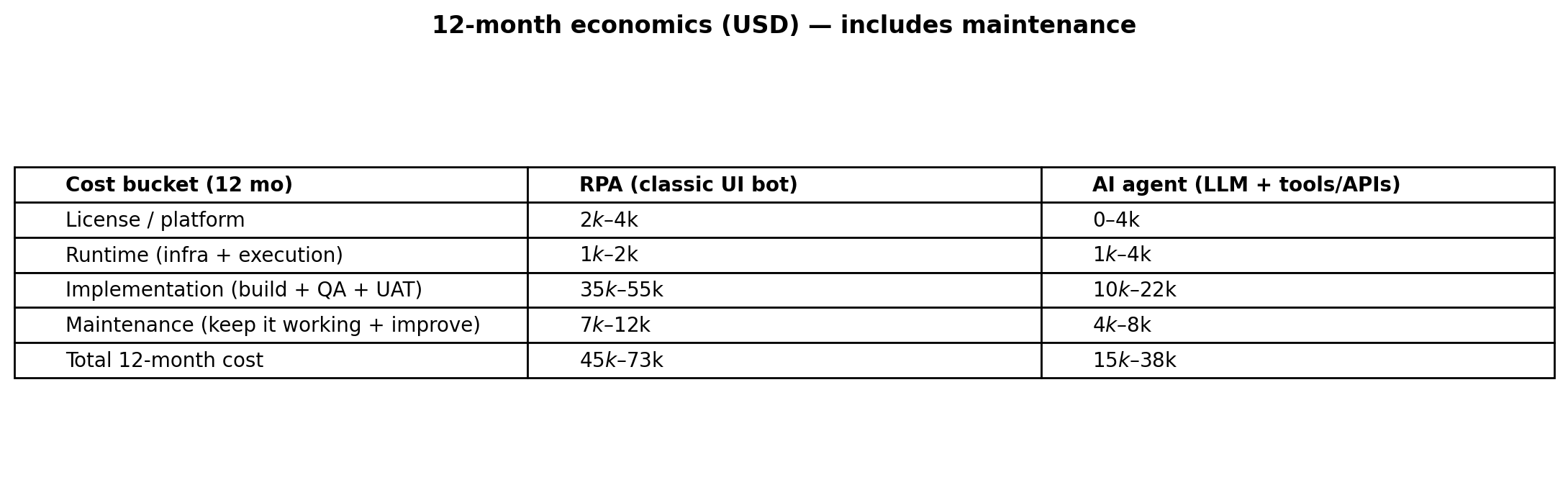
Similar comparisons can be done to LCNC tools, etc. Bottom line is that it clearly has benefits and unlocks new value but also clearly not "10x better".
These economics get compounded by the fact that organizational hurdles to doing small automations are significant and are largely the same between AI and non-AI.
These economics get further compounded by the fact that distributing self-serve software is not free and often shows up in price increases over time.
Projects too fragmented are in "ROI Nooks"
Because there is a minimum viable scale, significant fraction of work does not clear ROI hurdles and so does not get automated - it hides in "ROI Nook":
- One-off contractor paperwork for tiny subs: e.g., a 2–5 person subcontractor needs “perfect” COI/W-9/lien waiver packets a few times a year. The value is real, but each customer’s annual spend is too small to cover onboarding, support, and edge cases.
- Micro-fleet maintenance scheduling for owner-operators: a single truck / small van operator would benefit from predictive maintenance + parts optimization, but low utilization, messy data (no telemetry), and high “support per customer” makes it uneconomic.
- Smallholder agriculture optimization: irrigation/fertilizer/pest decisions for tiny plots. ROI exists, but fragmentation + low margins + variable conditions + weak instrumentation make deployment/servicing cost exceed value at scale.
- Neighborhood retail inventory: corner shops with thousands of SKUs and thin margins. The tech can help, but inconsistent POS systems, cash purchasing, supplier variance, and low willingness-to-pay make it a nook.
- Mom-and-pop compliance for low-frequency regulations: small clinics, salons, small manufacturers that face occasional audits. Automation could reduce risk, but purchase frequency is low and switching/support costs dominate.
Automation ROI Nooks thus are:
- tiny ticket sizes / fragmented buyers
- low margins / low wages
- low software utilization
- high variance + “support tax”
How much work is in ROI Nooks?
Let's take 3.6B jobs worldwide:
- Smallholders — 25%, 30% in nooks (this is even aggressive)
- Informal microfirms — 30%, 25% in nooks
- SMB — 30%, 15% in nooks
- Enterprise — 15%, 3% in nooks
This means that fully 20% of global jobs are not reachable via technology.
Originally published on LinkedIn.